
This Key Event Relationship is licensed under the Creative Commons BY-SA license. This license allows reusers to distribute, remix, adapt, and build upon the material in any medium or format, so long as attribution is given to the creator. The license allows for commercial use. If you remix, adapt, or build upon the material, you must license the modified material under identical terms.
Relationship: 302
Title
Reduction, Testosterone synthesis by ovarian theca cells leads to Reduction, 17beta-estradiol synthesis by ovarian granulosa cells
Upstream event
Downstream event
AOPs Referencing Relationship
| AOP Name | Adjacency | Weight of Evidence | Quantitative Understanding | Point of Contact | Author Status | OECD Status |
|---|---|---|---|---|---|---|
| Androgen receptor agonism leading to reproductive dysfunction (in repeat-spawning fish) | adjacent | High | Low | Evgeniia Kazymova (send email) | Open for citation & comment | WPHA/WNT Endorsed |
Taxonomic Applicability
Sex Applicability
| Sex | Evidence |
|---|---|
| Unspecific | Not Specified |
Life Stage Applicability
| Term | Evidence |
|---|---|
| Adult, reproductively mature | Moderate |
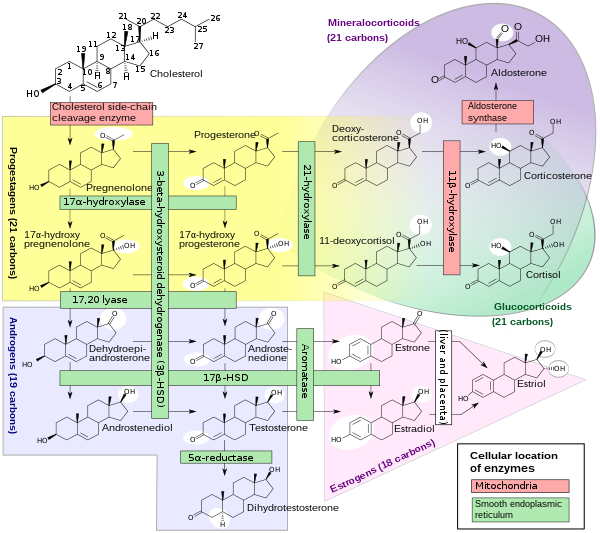
Figure 1. Overview of steroid biosynthesis pathway. Note, testosterone is converted to 17ß-estradiol through aromatization catalyzed by cyp19 (aromatase).
| ID | Experimental Design | Species | Upstream Observation | Downstream Observation | Citation (first author, year) | Notes |
|---|
| Title | First Author | Biological Plausibility |
Dose Concordance |
Temporal Concordance |
Incidence Concordance |
|---|
Biological Plausibility
Dose Concordance Evidence
Temporal Concordance Evidence
Incidence Concordance Evidence
Uncertainties and Inconsistencies
No significant inconsistencies identified to date. However, the literature review on this topic has not been comprehensive.
At present we are unaware of any well established quantitative relationships between ex vivo T production (as an indirect measure of theca cell T synthesis) and ex vivo E2 production (as an indirect measure of granulosa cell E2 synthesis). There are considerable data available which might support the development of such a relationship. Additionally, there are a number of existing mathematical/computational models of ovarian steroidogenesis that may be adaptable to support a quantitative understanding of this linkage (Breen et al. 2007; Shoemaker et al. 2010; Quignot and Bois 2013).
Response-response Relationship
Time-scale
Known Feedforward/Feedback loops influencing this KER
Enzymes required for testosterone and 17ß-estradiol synthesis are only found in vertebrates and amphioxus (Markov et al. 2009; Baker 2011). They are not present in invertebrates. Consequently, this KER is not applicable to invertebrates.